
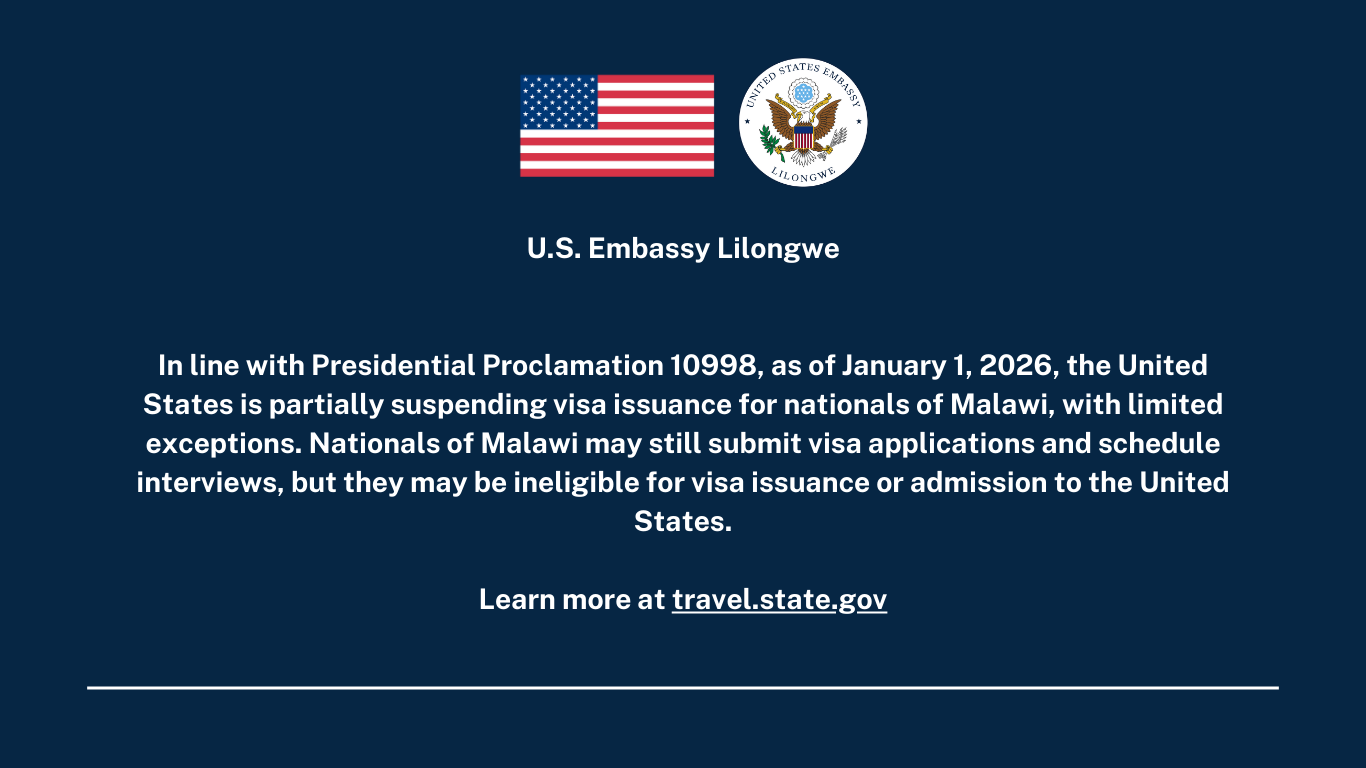
In what local policy analysts are calling a humiliating blow to international mobility, the United States Government has officially announced the complete suspension of routine visa processing at the US Embassy in Lilongwe, forcing all Malawian applicants to travel to Nairobi, Kenya for mandatory physical interviews. This bombshell directive, issued by the US Department of State, is scheduled to take full effect on August 1, 2026. Under this sweeping diplomatic restructuring, Malawi is among 25 Sub-Saharan African nations stripped of local routine visa services. Instead, Washington is consolidating its diplomatic footprint from nearly 50 processing points down to just 20 regional processing hubs. For local university students, corporate executives, and cultural creatives, this means that the road to America permanently runs through the US Embassy in Nairobi.
According to written correspondence from the US Embassy in Lilongwe, the decision is part of an aggressive, resource-driven security policy. The US Department of State defended the consolidation, stating that
This will strengthen US national security by promoting rigorous visa screening and vetting standards and better align resources and operational capacity with America’s national interests.
This move is further tied to Presidential Proclamation 10998, which placed Malawi under a partial visa suspension category, citing security and vetting challenges regarding citizen documentation. While Washington views this centralization as a necessary upgrade to bolster security and reduce immigration fraud, the immediate impact on Malawians is overwhelmingly negative. This creates a significant barrier for students,businesspeople, and professionals, adding layers of financial and logistical frustration to an already challenging process.
The new requirements are financially prohibitive for Malawi's ambitious youth, business leaders, and cultural pioneers. Beyond the $185 USD non-refundable application fee, applicants must now fund flights, meals, and hotel accommodation in Nairobi, turning a routine consular appointment into an expensive multi-day trip. This structural barrier directly penalizes local university graduates looking for postgraduate fellowships and young tech entrepreneurs aiming for Silicon Valley partnerships. Moreover, the added scrutiny under the partial suspension means a much higher risk of visa rejection, creating a high-stakes financial gamble where a student could lose thousands of dollars in travel costs just to receive an interview refusal. Malawi’s Minister of Foreign Affairs and International Cooperation, Nancy Tembo,highlighted the severity of the situation, noting that it creates an unjust logistical apartheid that will heavily impact education, medical, and business travel.
This shift effectively isolates Malawian talent from international opportunities and darkens the horizon for global cultural exchange. It creates a scenario where only the wealthy can afford to pursue American education or business ventures, severely limiting the potential for knowledge transfer and economic growth. The decision ignores the reality of Malawi’s youth population, which is packed with brilliant minds ready to export culture and innovation but bound by a weak currency. By placing these hurdles in front of a friendly nation, the policy alienates a vibrant base of young Africans who want to engage with global markets but are now locked out by geographical sorting.
To navigate this crisis, Miximelo News recommends that applicants pivot to digital document pre-vetting and ensure all academic or corporate sponsorship paperwork is absolutely perfected through the online portal before booking travel. Furthermore, prospective students should look closely at regional academic alliances or consider universities in the UK and Europe, where consular processing remains active and accessible locally. For those who must travel to Kenya, it is vital to budget for hidden travel costs, form travel cohorts to split accommodation fees, and explore temporary insurance to safeguard against unexpected passport delivery delays while stuck abroad.







Discussion
No comments yet. Start the conversation.